
Kessler
Kessler — the town that isn’t quite what it seems.

Kessler - 1940.
Nestled on the southern edge of the Mont Noir massif, Kessler is a modest but quietly industrious French town whose character is shaped as much by the land as by the people who have worked it for generations. The town sits where the dark, forested slopes of Mont Noir taper into a broad expanse of marshland, known locally as Les Marais de Kessler—a shifting landscape of peat bogs, reed beds, and slow, amber-coloured channels.
The Mont Noir foothills rise to the west, thick with pine and beech, their lower slopes giving way to miles of marshland — a place of mist, migratory birds, and treacherous ground known only to locals. The town stands on one of the few patches of firm, elevated earth, its main cobbled road running straight through the centre.
Tall, narrow buildings of three and four storeys press close to the street, their ground floors taken up by shops and workshops, with cramped apartments stacked above.
Behind the main street, a tangle of narrow lanes threads between rows of stone cottages, their gardens hemmed in by low walls and leaning sheds. A slate-roofed church rises above them, its bell tower visible from almost anywhere in town. Beyond that sit the industrial workings — the resin factory with its sour-sweet smell, the timber sheds, the yard where carts and barrels are stacked in uneven rows. Kessler feels both close-knit and insular, a place shaped as much by its landscape as by the people who’ve endured it for generations.
Yet Kessler is not without its strange happenings. People speak of sounds drifting out of the marshlands at night — low, carrying cries that don’t belong to any bird, and pale figures glimpsed moving through the reeds when the mist is thickest. The church, too, has its stories: a shadow said to cross the nave long after the doors are locked, and footsteps heard on the gallery when no one is there. And no one, not even the bravest of the resin workers, goes into the Forêt des Saints after dark. They say the trees whisper there, and that the forest remembers things better left forgotten.
Kessler feels both close-knit and insular, a place shaped as much by its landscape as by the quiet, persistent weight of the things people prefer not to talk about.
Main Industry in the 1940s (Pre-WWII)
In the years leading up to the Second World War, Kessler’s economy revolved around three interlinked industries, each tied to the marshlands and the forested slopes.
1. Peat Extraction (Primary Industry)
The marshlands are rich in peat, and for decades Kessler has been known regionally for its peat-cutting operations. Before widespread electrification, peat is still a valuable fuel source for local households, small industries and even nearby towns and villages lacking coal access.
Peat cutting is seasonal, physically demanding, and deeply traditional—families often work the same plots for generations.
2. Timber & Resin Harvesting
The Foret des Saints support a steady trade in timber (construction, carpentry, railway sleepers) and resin tapping which was used in varnishes, adhesives and early industrial compounds.
Small sawmills and resin distilleries line the western edge of town, their chimneys a familiar sight.
3. Marshland Craft & Cottage Industries
The marshes provide materials for a range of artisanal trades. Reed weaving (baskets, chair seats, fish traps) were made by traditional methods passed down by general and exported across Europe. Marsh herbs were harvested ad used in traditional remedies and tinctures. These crafts were often carried out by women and older residents, forming a quiet but essential part of the local economy.
Social & Cultural Identity
Kessler’s people are known for their resilience and practicality. Life in and around the marshlands demands deep local knowledge, a respect for the land and a sense of community. Many people have died in the marshlands because of their inexperience and ignorance.
The town hosts an annual Fête des Marais, celebrating the marsh harvest, with music, food, and competitions in peat-stacking and reed-weaving.
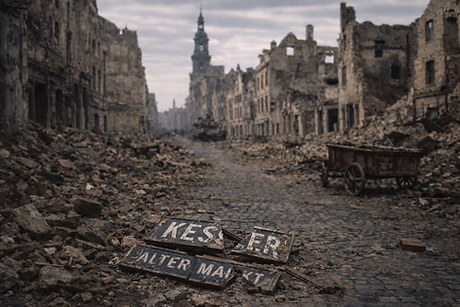
Kessler - 1944.